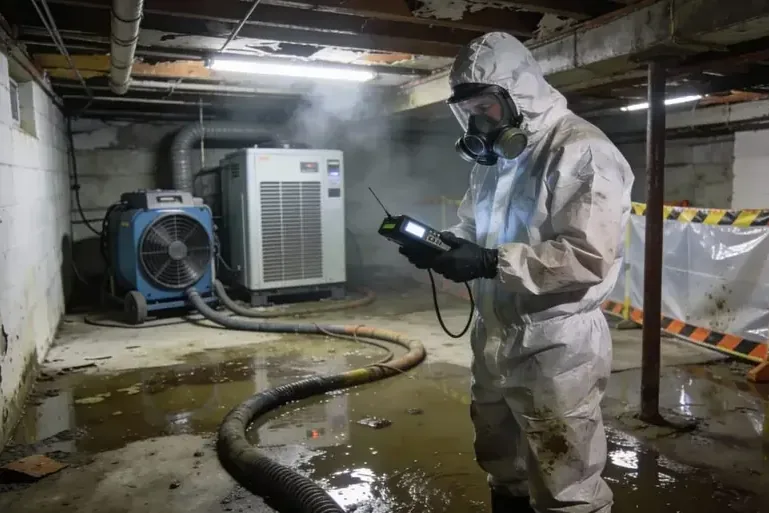
Hamtramck has a combined sewer system, so sewage and rainwater share the same pipes. When a downpour fills those pipes, the overflow looks for the lowest opening it can find, and in a house with a basement that is usually the floor drain.
Key takeaways
- Water that comes up through a drain in a combined sewer is sewage, not just rainwater.
- Backups were reported in May 2011, early September 2014 and June 25 to 26, 2021.
- Do not touch the water, and keep children and pets away from it.
- Porous materials the water touched are removed, and hard surfaces are cleaned and treated before drying.
- Photos, a contents list and drying readings make the record complete.
What a combined sewer means for a basement
In a combined system, household wastewater and storm water run through one set of pipes. In dry weather that works.
In a hard rain the pipes can fill faster than they empty.
When that happens, the water has to go somewhere, and the lowest drain in the building is the usual exit.
Why the water counts as sewage
The flow carries wastewater, so anything that comes back up a drain is treated as Category 3. That means protective gear, removal of porous materials and cleaning with antimicrobial treatment.
Clear looking water changes nothing, because the contamination is not something the eye can judge.
Backups on the record
Local reports and news coverage give a clear picture of how the system behaves in heavy rain.
- May 25, 2011: 2 inches of rain fell in less than an hour and overwhelmed the sewer pipes. Sewage backed up into a number of basements, and some residents reported up to 4 feet of water.
- May 2011: the viaducts on Joseph Campau and Holbrook became impassable, and public works crews removed sewer grates to speed drainage.
- Early September 2014: residents again reported sewer backups in a heavy downpour.
- June 25 and 26, 2021: storms backed up the combined sewer into basements, and the governor declared a state of emergency for Wayne County.
- August 17, 2021: a FEMA Disaster Recovery Center opened at City Hall on Evaline Street for the June storms.
- March 10, 2023: a court gave preliminary approval to a settlement of the class action over the June 2021 basement flooding.
Sewer projects and what they mean for a homeowner
In late August 2023 FEMA announced funding for the Hamtramck Phase 1B Relief Sewer Project. It is described as collecting combined sewage from specific trunk sewers and carrying overflows to an existing relief sewer.
Whatever the status of a project, nothing changes what a homeowner does when water is rising in a drain: stay out, keep others out and call for help.
How to tell a sewer backup from other water
Not every wet basement is a sewer backup, and the difference sets the cleanup. A few signs separate the two.
When in doubt, treat the water as sewage until a crew has checked the source.
- Water rising through a floor drain, a tub drain or a toilet.
- Dark, cloudy water with a sewage smell.
- Gurgling sounds from drains during or after a heavy rain.
- Several fixtures draining slowly at the same time.
- Water that appears after a downpour, with no broken pipe anywhere in the house.
The first steps when sewage water comes in
The first steps are about safety and containment, not about saving carpet. Contact with the water is the main risk.
Once everyone is safe, calling for sewage backup cleanup starts the extraction while the water is still shallow.
- Stay out of the water and keep children and pets away.
- Turn off power only if the panel can be reached without stepping into water.
- Stop using toilets, sinks, the washer and the dishwasher, which feed the same drain.
- Do not use a household vacuum on the water.
- Photograph the water level and the damage before anything is moved.
What gets removed and what is cleaned
Sorting is based on porosity. Whatever soaks the water up, such as carpet, pad, insulation and low drywall, is removed.
Dense materials are cleaned.
Hamtramck has 5,258 housing units built in 1939 or earlier, and the median home was built about 1938. In a house of that age, trim, flooring and finishes may be original and worth saving, so the team tests before it tears out.
Usually removed
- Carpet and pad that touched the water.
- Insulation and drywall below the water mark, plus a margin above it.
- Cardboard, paper and fabric that soaked it up.
Usually cleaned
- Concrete slab and block walls.
- Solid wood framing, which is cleaned, treated and dried.
- Metal, glass and hard plastic items.
Belongings
Soft items such as upholstery, mattresses, stuffed toys and cardboard boxes that sat in sewage water are usually discarded.
Hard items that can be washed and treated, such as tools and plastic bins, are often kept after cleaning.
Drying and a final check
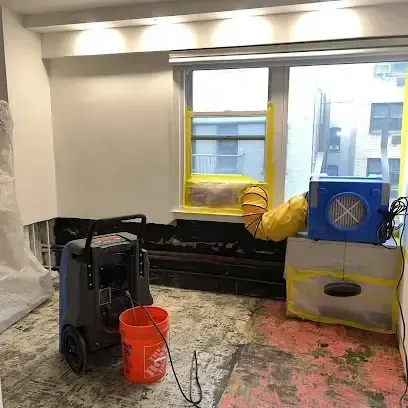
After removal and cleaning, the team dries the room with air movers and dehumidifiers and takes readings each visit. Basement flooding cleanup follows the same sequence, with extra steps for sewage.
The job is complete when the readings match a dry reference and the surfaces have been cleaned to a safe condition, not on a set day.
How the days usually run
The first visit covers extraction, the removal of porous materials and the first round of cleaning. Equipment is set and the first readings are taken.
Later visits check the readings, move equipment and confirm that the surfaces are clean and the room is drying as planned.
Records and what they are for
A FEMA recovery center and a class action both followed the June 2021 flooding, which shows how much depends on records. Dated photos and notes are the foundation of any later conversation.
The restoration team keeps its own moisture readings and logs, and those belong in the same folder as the household photos. More about local work sits on the Hamtramck hub.
- Photos of the water level, the source drain and the damage.
- A room by room list of damaged items, with a rough age and value.
- Notes on when the water came in and what was done next.
- The drying readings and the cleaning notes from each visit.
Questions
Is water from a floor drain in Hamtramck always sewage?
Because the city has a combined sewer, water that comes up a drain is treated as sewage. It is handled with protective gear and removal of porous materials.
Can carpet that touched sewage water be saved?
No. Carpet and pad that touched sewage water are removed, because they cannot be made safe again.
Can the basement be used while it dries?
It is better to stay out until the cleaning and the dry out are done. The air can carry contamination and the floor can be slippery and unsafe.
What if the basement floods again in the next storm?
Take photos each time and keep the drying records. A cleanup and a dry out are repeated each time, and moving valuables off the floor helps.
Should someone call the city?
Backups can be reported to the city. The restoration team handles the cleanup inside the home and keeps its own records.
Why are children and pets kept away from the water?
Sewage water carries bacteria and other contaminants, and children and pets are more likely to touch the water and then their faces.