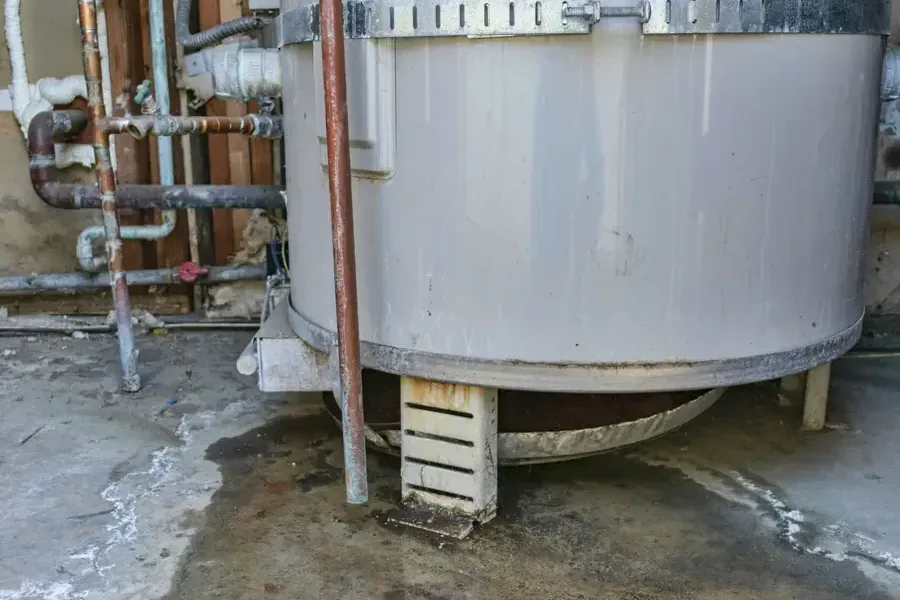
Most homes in Grosse Pointe were built before World War II, and nearly all of them have full basements. That is where the aging water heater sits, often a few steps from a laundry area, a finished rec room or shelves of stored boxes.
Key takeaways
- A tank that weeps at the base, shows rust streaks or rumbles while heating is telling the owner it is near the end.
- Shut off the cold water supply to the tank and the power or gas before touching anything else.
- A failed tank usually soaks the nearest wall, the floor and everything stored on it, so contents come first.
- A slow leak that ran for weeks turns clean water into Category 2 water and widens the removal.
- Replacement is the repair, because a leaking tank cannot be patched.
Why basement tanks fail late and fast
A tank is a steel shell with a thin lining. Over the years the lining wears, minerals settle at the bottom and the steel starts to corrode from the inside.
The failure often shows up as a puddle rather than as a warning, because the first pinhole is hidden under the tank or behind a jacket.
Signs worth acting on
Most tanks give a few hints before they let go, but the hints are easy to read as normal noise.
- Rust streaks or flaking at the base of the tank.
- A damp or stained floor under the tank or around the drain valve.
- Rumbling or popping while the water heats, which points to sediment.
- A relief valve pipe that drips more than once in a while.
Where the water goes
In a prewar basement water follows the slab to the lowest spot, and it also climbs into the bottom of any wall it reaches.
That is why a small pool near the tank can be the visible end of a much wider wet area.
Slow seep or sudden failure
The two failures look different on the floor, and they are cleaned differently.
A sudden failure
A seam opens or a fitting lets go and the tank empties across the floor. The water is clean at first and the damage is mostly from volume.
Fast extraction keeps most of the harm to the bottom of the walls and the stored items.
A slow seep
A pinhole drips for weeks, and no one notices because the water evaporates or runs to a drain. The slab stains, shelving rusts and a musty smell builds.
Water that has been wet for that long counts as Category 2, so more material is removed and the area is cleaned before it is dried.
Shutting it down safely
The order matters. Stopping new water and removing the heat source prevents a second problem on top of the first.
Hot water from a failing tank can scald, so stay clear of the discharge and wait for the tank to cool before working near it.
- Close the cold water inlet valve above the tank.
- Turn off the breaker for an electric tank, or the gas control for a gas unit, and leave the building if gas can be smelled.
- Open a hot tap upstairs to let the pressure drop.
- Leave water on the floor alone until the power to nearby outlets is confirmed off.
If the tank is gas
Close the gas control, and if there is any smell of gas, leave the building and keep flames and switches out of it. The gas utility handles that emergency, not the drying team.
If the tank is electric
Turn the breaker off before anyone steps near wet floor around the tank. Never reach into water that could touch a live element or a cord.
Check the boiler too
Many prewar homes also have a boiler for radiators in the same basement. A wet floor near the utility area is not always the water heater, so a quick look at the boiler, its piping and the radiator valves helps find the true source.
What a failed tank soaks and what is saved
A full tank holds enough water to cover a basement floor with a thin sheet, and the sheet reaches farther than it looks.
The water spreads under shelving, into the bottom of paneled or drywalled walls, and into anything that sits on the ground. If the tank sits near a finished rec room, carpet and pad can wick water in from the edge.
Contents come out of the wet area first, before the water has time to climb them. Plastic bins can often be wiped and kept, while cardboard, paper and fabric that sat in water are usually discarded.
Finished walls are opened a little above the damp edge so the cavity can dry. Leaving them closed holds water against the framing and lets the damage keep growing out of sight.
- Cardboard boxes and papers wick water up and fail first.
- Carpet pad and the tack strip along the wall hold moisture for days.
- The base of drywall or paneling absorbs water from the floor side.
- Furnace and laundry areas share the same slab, so the water reaches them too.
How the cleanup runs
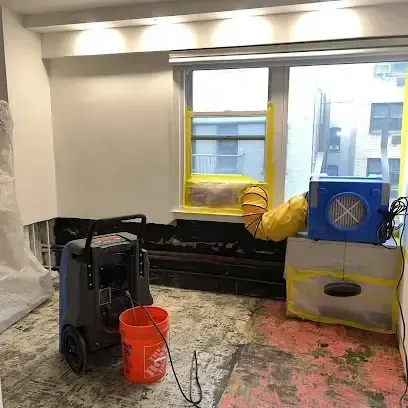
The first job is water extraction, pumping or vacuuming the slab so the water stops moving into materials.
Then the crew checks the wall and floor edges with a moisture meter and decides what is opened. The steps differ for each kind of leak, and water heater leak cleanup covers the common cases.
After removal, the slab and the open wall bays are dried with air movers and dehumidifiers until the readings return to normal.
Replacing the tank and avoiding a repeat
A plumber replaces a leaking tank, and the drying team works around that schedule so the room is not rebuilt too early.
A drain pan piped to a floor drain, a working relief valve pipe and a look at the tank every season catch most problems early. For leaks that spread beyond the utility area, basement flooding cleanup covers the larger scope.
- Note the age of the tank when it is replaced and plan the next one.
- Keep the area around the tank clear so a drip is visible.
- Check the base and the relief valve pipe every season.
- Keep valuables and paper on shelves, not on the slab.
Questions
Can a leaking water heater be repaired?
A leak from the tank body cannot be patched. Fittings and valves can sometimes be replaced, but a tank that leaks from the shell is replaced.
How much water can a failed tank release?
A full tank can empty onto the floor, and the supply keeps feeding it until the cold water valve is closed. That is why the shutoff comes first.
Is water from a water heater clean?
At first it is usually Category 1. After it sits in carpet, cardboard or soil it degrades, and a leak that ran for weeks is treated as Category 2.
Should the tank be drained after a leak?
Leave that to the plumber who is replacing it. The cleanup focuses on the water already on the floor and in the walls.
Do stored boxes need to be thrown out?
Cardboard and paper that sat in water usually go. Plastic bins, metal and glass can often be cleaned and kept.
How can the owner tell a water heater leak from a boiler leak?
Follow the water to its source. A tank leak comes from the base or the fittings on top of the tank, while a boiler leak shows at the boiler, its valves or the radiator piping.