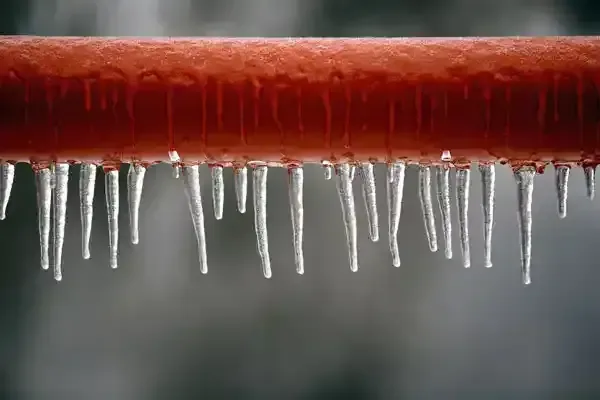
On December 26, 2022, with temperatures around 16 degrees, the old boiler at the historic Gianna House shelter in Eastpointe could not heat the third floor, and PVC fire prevention pipes there burst. Hundreds of gallons ran down the walls into the basement, damaged all four floors and closed the shelter.
Key takeaways
- A heating failure on one floor can put the pipes on that floor at risk, even when the rest of the building is warm.
- State of Michigan guidance names pipes in crawl spaces and attics as the most likely to freeze, and advises a thermostat setting no lower than 55 degrees.
- Water from a burst pipe runs down inside walls, so the damage can show up floors away from the break.
- A frozen pipe often splits without leaking until the ice melts, so the flood starts during the thaw.
- Shut the main valve first, then call for extraction and drying before the walls stay wet.
What happened at the Gianna House
The Gianna House is a historic shelter, and its December 2022 burst shows what a single cold floor can do to a whole building.
The sequence
- The old boiler could not heat the third floor on December 26, 2022.
- The temperature was about 16 degrees.
- PVC fire prevention pipes burst on the unheated floor.
- Hundreds of gallons ran down the walls into the basement.
- All four floors were damaged and the shelter closed.
What it shows
One heat source failed on one floor, and the water did the rest.
The same chain can start in a house when a furnace zone quits, a room is closed off or a vacant space is left unheated.
Why unheated spaces are the weak point
State of Michigan guidance says pipes in crawl spaces and attics are the most susceptible to freezing, and it advises keeping the thermostat at 55 degrees or higher.
Pipes in exterior walls, garages, sunrooms and closed off rooms face the same risk, because the cold reaches them faster than the heat does.
Cold snaps make the problem regional. In January 2026 plumbers across Metro Detroit reported more frozen and burst pipes during extreme cold.
Where to look first
A quick walk through the house finds most of the weak spots. The goal is to find every pipe that has an outside wall, a cold space or a closed room on one side.
- The crawl space or the basement ceiling where pipes run along the rim.
- Attic runs, especially near the eaves where insulation is thin.
- The wall under a kitchen or bathroom sink on an exterior wall.
- Garages, sunrooms and enclosed porches with a supply pipe.
- Rooms where the vents are closed or the heat has been turned down.
Warning signs on a cold morning
A pipe often gives notice before it splits. The signs are easy to miss when the house is busy.
Acting on any one of them is cheaper than cleaning up after a burst.
- A faucet that gives only a trickle or nothing on a hard cold morning.
- Frost or a white coating on a pipe that can be seen.
- A pipe that bulges or a joint that looks stretched.
- A bang or a knock in a wall when the water is turned on.
- A room that stays far colder than the rest of the house.
A fall checklist before the first hard freeze
Most freeze damage can be prevented in October, long before the cold arrives. A walk through the house with a short list is enough.
- Insulate pipes in crawl spaces, attics and along exterior walls.
- Keep the thermostat at 55 degrees or higher, even when the house is empty.
- Heat every floor, including rooms that are rarely used.
- Disconnect garden hoses and shut off outdoor faucets.
- Open cabinet doors under sinks on exterior walls during a hard freeze.
- Have the furnace or boiler checked before the cold, not after it quits.
- Know where the main water valve is and make sure it turns.
When a pipe splits: the first steps
A frozen pipe is a plumbing problem until it splits, and then it is a water damage problem. The order of the first steps matters.
Calling for frozen pipe burst cleanup early keeps the water from soaking in while the plumber is on the way.
- Close the main water valve.
- Open taps to drain the pipes and relieve pressure.
- Turn off power to any area where water reaches outlets or fixtures.
- Photograph the burst pipe and the wet areas before cleanup.
- Move belongings out of the path of the water.
How the water travels and what gets wet
A burst pipe does not stay where it breaks. Gravity pulls the water along the pipe, through framing and down to the lowest floor.
Inside the walls
Water that runs down a wall wets insulation, drywall and the bottom plate long before it reaches the ceiling below.
The Gianna House water went down the walls to the basement, which is why all four floors took damage.
Across several floors
In a multi floor building or a two story house, each ceiling and wall cavity the water crosses is another place for it to sit.
A burst pipe water damage job often means opening each level to find where the water stopped.
Cleanup and drying after a burst
Supply water starts clean, but it does not stay clean once it soaks carpet, insulation and building materials.
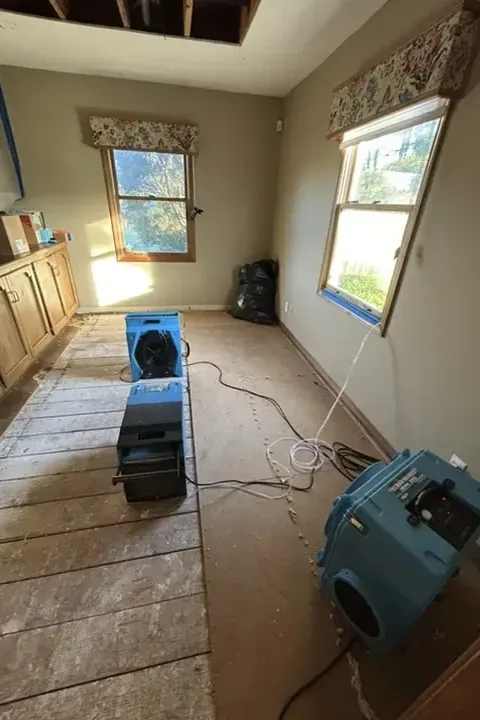
The extraction crew removes standing water, the team opens wet walls and ceilings, and air movers and dehumidifiers dry the structure until the readings are normal. Local detail for the area sits on the Eastpointe hub, and the main page for frozen pipe cleanup lists the common scopes.
- Standing water is extracted from each affected floor.
- Wet insulation and drywall are removed where the readings are high.
- Wall and ceiling cavities are dried with airflow and dehumidification.
- Readings are logged until the structure matches a dry reference.
Why several floors matter
A job that starts at a single burst can end up covering a basement, a ceiling and a wall on each floor above it. Each one has to be dried to its own reading.
That is why the team checks the lowest floor first and works up, following the water along the path it took.
Questions
How cold does it need to be for pipes to freeze?
Pipes in unheated spaces can freeze when the cold holds for a long stretch, and wind and drafts speed it up. A heating failure can put a room in danger even on a moderate winter night.
Why does the water show up after the thaw?
Ice can plug a split pipe. When it melts, water flows through the crack and the leak begins, often when no one is home.
Can a frozen pipe be thawed without a plumber?
A pipe that is exposed and has not split can be warmed gently with a hair dryer or warm towels. Never use an open flame, and call a plumber if the pipe is behind a wall.
Is water from a burst supply pipe clean?
At first it is usually clean. It degrades after soaking carpet, insulation and other materials, so quick extraction matters.
How long does it take to dry after a burst pipe?
It depends on how many floors were wet and how long the water sat. The readings decide when the job is finished.
What should be done if the house will be empty for the winter?
Keep the thermostat at 55 degrees or higher, shut off the main valve if the house will be empty for a long time, and have someone check the house during hard cold.